
Blade geometry
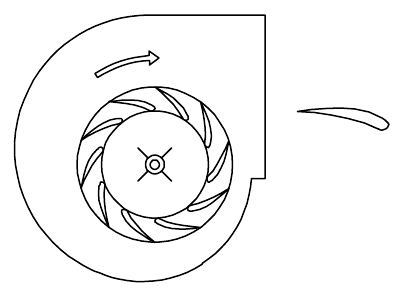
| Blade form | Backward, aerofoil section |
| Exit blade angle | Below 90° |
| Number of blades | 10 to 12 |
| Air leaving the impeller | At a velocity less than the blade tip speed. Deep blades give efficient expansion within the blade passages, and the aerofoil section lowers the blade losses further. |
Where it is used
- Large volume clean air duties where power saving is the priority
- Ventilation and process air supply
- Clean air industrial fans running continuously
Selected for clean air only. The hollow blade is not suited to erosive or dust-laden gas, where a backward inclined or radial blade is offered instead.
Applications selected with this blade
| Application | What it does | Type usually selected |
|---|---|---|
| FD Fan | Supplies combustion air to a boiler or furnace, pushing ambient air through the air heater and into the windbox against the furnace draft. Clean air, so the blade is chosen for efficiency. | Backward curved and backward inclined |
| Ventilation Fan | Moves air through a plant or building for fresh air supply, heat removal and fume dilution where the system is ducted. Low pressure, long hours, so efficiency and noise set the selection. | Backward inclined and forward curved |
| HVAC | Supply, return and exhaust fans for heating, ventilation and air conditioning of plant and office space. Low pressure, so efficiency and noise govern. | Axial, backward inclined and forward curved |
Industries
BoilerSugarPowerIron & SteelOil & GasPaperDyeing IndustriesTobaccoTeaFood ProcessingAutomobileSurface CoatingTyreShipbuildingNuclearChemical & Pharma
Drive and construction
Offered direct mounted on the motor shaft, direct coupled, or belt driven. Material of construction follows the medium and temperature: mild steel, stainless steel, PP-FRP lined, MS FRP lined or MS rubber lined.
Testing and balancing
Performance tested as per IS 4894, BS 848 Part I, or as per customer standards. Rotors are statically and dynamically balanced to grade G 6.3 or G 2.5 as per ISO 21940-11.
Information needed to select or quote
- Duty point. Volume flow and static pressure at the fan inlet, with the gas density and temperature or the conditions to derive it.
- Operating conditions. Site altitude, normal operating temperature and continuous or intermittent duty.
- Gas stream. Dust loading and particle size, corrosive species, moisture, upset temperature and any tendency of the material to deposit on the impeller.
- Mechanical. Rotation viewed from the drive end, discharge orientation and motor power.